Sunday, 28 February 2016

February - When nice weather brought a leopard seal and new-born wandering albatross chicks to Bird Island

The weather over the last few months has been rather nasty, apparently even by Bird Island standards for the summer. This month however we've been blessed with a few lovely days of sunshine and little wind. I'll make up for the lack of photos in my last entry by letting the photos do most of the talking this month.
A female wandering albatross practices nest building
A wandering albatross, still waiting to fledge at this late date.

A giant petrel gulps down the remains of a seal flipper after a few attempts.

A lovely chinstrap penguin who visited the macaroni penguins at 'big mac'.

Earlier this month we had our first leopard seal sighting. A young male made a very early appearance, as they are normally winter visitors.

It did provide a good training opportunity for me to learn how to photo-identify leopard seals however, and a rare opportunity to see young fur seal pups alongside this top predator.

A fur seal pup with a ginger mustache and shrek ears.

A moody moulting gentoo penguin with a feather caught on his beak.

Wandering albatross display to each other on the meadows

Is three a crowd?

One of my favourite wanderer photos

A male wandering albatross looks down to check underneath him

Yup, the chick is still there! One of the first hatched on Bird Island.

A wanderer takes flight.

Prion pond, with tonk in the background.

An albatross flies between Bird Island and Willis Island

A moulting pup has gone for the aging man look.

The view from atop Gazella on a lovely day.

Wednesday, 17 February 2016

Seals, birds and whales - pretty much the title of all blogs henceforth

As mentioned previously, and on the blog on the official BAS website (https://www.bas.ac.uk/blogpost/antarctic-blog-exploring-an-island-abundant-with-wildlife/ ), the seal season is a lot quieter now than it was a month ago. We've just got a few things to wrap up, and then the main focus will be learning techniques for my winter as the only seal biologist on Bird Island. During this time I'll catch up on lab and computer work to get all the data ready in time for a report to CCAMLR. After we see the first leopard seal around or on the shores, I'll start a daily 'lep round', looking for individuals in the water or hauled out, documenting their behaviour, collecting scats for diet analysis, biometrics and photos for identification purposes. There will also be a rush to finalize all of the documentation and shipping preparations for last call in April, where all of our samples will leave with our fellow summer team,  exchanged for some post from home and hopefully some fresh food for the four of us staying behind for the winter. This year isn't as straight forward as some have been. As Lucy has extended her stay by a year (totaling 2.5 years!), she is going home for 6 weeks to see loved ones, so Jerry will be staying on the island for the first 6 weeks of winter before heading home when Lucy returns.

In the meantime however, I'm enjoying having a bit more time during the day to go out and spend time with the growing and moulting pups, and to get involved with other jobs. These have included getting hands on with macaroni penguins and molly albatross (grey-head and black-brow). I've also been spending some time up on wanderer ridge overlooking Bird Sound (the 500m wide section of water that separates us from mainland South Georgia) and on Gazella (a rocky hill behind base, that overlooks the dramatic north cliffs). This isn't just to enjoy the view however, I've been devising a protocol for a standardized cetacean survey. There are quite a few cetacean sightings from Bird Island every year, although these are purely incidental and there is no effort related data to show how much time is spent looking out to sea. This means that for the most part, it is simply a number of whales seen and not much can be done with this data to look at trends in occurrence across months, years or weather conditions. I'm hoping to change this, even if it does mean a bit of extra work! I've had a fair bit of experience in the UK and Ireland watching out for smaller cetacean species, and surveying for whales in California. However, this is the first time I'm starting a survey from scratch, which is exciting! Of course, Bird Island is fairly famous for its mist, high winds and nasty weather, so I'm hoping for some decent days to get some surveying done to iron out initial creases in the protocols.


Thursday, 28 January 2016

January goings on

The seal scene has changed dramatically over the last few weeks. The beaches are nearly empty now, you can walk along the tide line without being challenged, and the tussock is busier with females and pups. The pups have earned their proficiency in swimming badge and are confidently playing in the shallows, sometimes using bursts of speed to porpoise out of the water. As there wasn't a pup born at SSB for 7 days in a row, we have now stopped our daily visits. Our work-load has reduced considerably, and now I take a daily walk up into the valleys to look for known-seals and collect scats for analysis. This extra time also allows me to get more involved with the other study species on the island, and I've recently made my way to little mac with Tim and Al to work with the macaroni penguins. I've also tagged along with giant petrel work, and take a map of wandering albatross nests out to read the ring numbers of partner birds that haven't yet been identified. To accomplish this, you take a clipboard to shield your hand (and face) from their beak, and reach underneath them to twist the leg ring so it can be read.

I've also been using this spare time to finally start taking photos that aren't a rushed snap from outside base. I'm keen to get more involved with the bird work, and Sunday will see everyone leaving base to do the first all-island wandering albatross (wanal) census of the year. During this we are assigned an area of the island, which we cover and check nests for hatched or failed eggs, and place a marker stake next to any newly inhabited nests whilst noting down the ring number and sex of the incubating adult.

Also this month, we have had a few ship visits. We've had two yachts come into the bay in front of base to have a look around and have a chat over VHF, and also the Pharos dropped several RIBs full of people and supplies ashore. Not only did we get a few boxes of fresh food (avocados and bananas were very appreciated!), some post (a christmas card from my aunts which was an unexpected and very nice surprise), but we also showed approximately 10 Falkland Island and South Georgia government officials, and Princess Anne around base and took them up to see the wanderers. 
Macaroni penguins with chicks at little mac

Grey-headed albatross and chick


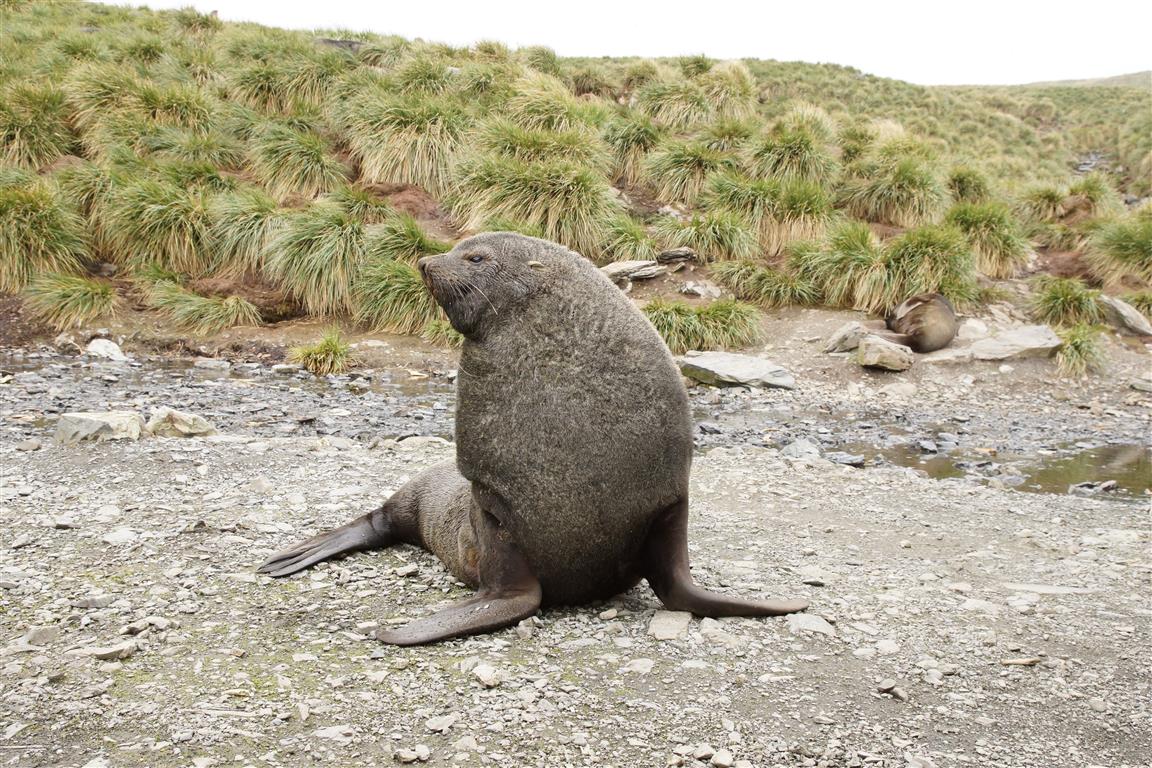
One of the few remaining big male furries having a rest

Attempting to land

There is a lot of rain on BI, and it has to go somewhere!

Blonde puppy! (Notice the blonde fluff in her 'toenails')

King penguins at Main Bay
Fur seals looking across the bay towards base.
A chinstrap penguin visits SSB. It's nice to see one of the rarer species.
A blonde female tells a young male to back away.

Tuesday, 5 January 2016

Seal (p)update


The seal side of work on the island has slowed down considerably, giving myself and Sian a chance to catch our breath and relax a little after the last 5 weeks of non-stop seal research. We’ve been visiting the Special Study Beach (SSB) twice a day, every day, to make note of which male fur seals are holding territory, when females arrive (and whether they are known individuals with tags), and when they pup. There have been 385 births so far, with a peak of 28 born in a single day. This has slowed down to around 2 or 3 a day at the moment, and is expected to continue to drop until there are no more births, and we don’t need to go to SSB anymore in a few weeks time. After this, we’ll continue to perform scat analysis (identifying and measuring the contents of 15 scats per week) in the lab, and keep an eye on comings and goings on the beach in front of base.

A male makes a dash up the stream, trying to avoid other territorial seals

Unlike the elephant seals, fur seal mothers return to sea after the initial few days with their pups to replenish their resources before coming ashore once more to feed their pups. During this unsupervised time, the pups normally explore the beach and pester all the inhabitants. They even come up to base to line our doorsteps, and sleep on everything interesting they can find. This can sometimes make going through doors interesting, as you either have to watch where you step, or a pup will be hiding nearby and all you’ll hear is a growl, which for a split second can sound like an angry male who you don’t want to be surprised by! 
Princess and the pea, pup style.
A proud male


Sadly, this year the pups aren’t doing too well. The mortality at SSB is double that of this time last year, and it’s expected to be due to the mothers not finding the krill that they rely upon during the summer months. It’s too early to conclusively say, but the strong El Nino is likely to play a part. This means that not only are we ‘walking to work’ (SSB) past dead pups and seeing them there, but they are also literally dying on our doorstep. Thankfully, the pups that are still alive, and even thriving in some cases, are very cute and make everything seem a bit more cheerful!
Kelp is a favourite toy, and even better when combined with swimming around in pools.

A pup who thinks he is formidable, but is actually just very cute!

It’s now getting to the stage where the males are slimmer and will soon return to sea, heading South to feed and build up their fat reserves again for next year.  The females will continue to return to feed their pups, which will (hopefully) grow to be big, strong, and fast. For now though, most of them are still rather small and adorable.

 
Pups sleeping on our doorstep


It is a strange thought that I'll be seeing the same spectacle again next year when I'm still here, and celebrating new years eve with the next group of ZFA's. It’s an amazing place here, with stunning wildlife which makes it a very varied island despite the small size. You have to stay alert amongst the seals on the beaches, watching out for males who think you’re a threat to their females, or a young male who seems almost to have something to prove. Of course, the pups are the biggest danger on the beaches, growling and baring their teeth so enthusiastically that they sometimes fall over backwards. Things change quickly here, one second you can be moving swiftly away from a male, and the next be saying 'awww' and laughing at a puppy playing with some feathers. Away from the beaches and into the first layer of tussock you’ll find a few sporadic pups, females and males. Past that, everything seems a lot more relaxing. There are currently chicks of various birds in nests, including brown skuas, macaroni penguins, and several species of albatross. It’s nice to take some time away from the seals every so often and enjoy the views from one of the hills, or head over to ‘big mac’ to see 65,000 macaroni penguins.  There is still so much of the island that I’m yet to see, which I’ll hopefully manage to explore now that I have a bit of extra time. Helping out the other Zoological Field Assistants (ZFA’s) is the perfect excuse to see more, and I’ve been out helping check on skua chicks and eggs, assisted in the ringing process of giant petrels, and helped to weigh wandering albatross chicks, and check on the new cohort’s nests and eggs.

 I'll be sure to make the most of the seals whilst they are still around, especially having wildlife so predictably close to base, which I'm sure to miss during winter.
Pups guarding the door to the lab

Not a bad view really


Tuesday, 22 December 2015

Arrival at Bird Island, South Georgia


I am writing this blog a month after arriving on Bird Island, South Georgia, where I am living and working until April 2017. It has been a full-on, but very enjoyable first exposure to the island and it’s wildlife. Bear with me whilst I try to remember what happened before my sudden and awe-inspiring introduction to this little grassy and boggy rock and it’s angry inhabitants (the animals, not the previous winterers!). We arrived on the JCR several days later than scheduled due to the thick sea ice spreading north of Signy. We came to Bird Island first before King Edward Point (KEP – the base on mainland South Georgia) to see if the weather would allow us to land. We arrived to heavy winds whipping water off the surface of the ocean, and driving snow.

 
We waited throughout the day for a weather window, which we thought had materialized before dinner so we gathered our bags and cleaned our rooms, only to be told that we would be staying another night. In the few hours I had been waiting on deck, my room had become occupied by a cruise scientist, so I spent the night sharing with Ian, the tech joining us for a year on BI. We woke up at 4am the next day, donned dry suits and life jackets, and went ashore.

The view of base with La Roche behind, taken from the jetty.
We were greeted warmly by the winterers, and had a few hours to orientate ourselves whilst the ship decided whether the weather was good enough to send a cargo tender out to us with cargo. After a quick tour of base, we were taken on a walk around the area near base. We went over the hill to SSB (Special Study Beach – where I spend the majority of my time in the summer, working with the seals from a raised gantry), across landing beach where gentoos were nesting, and up to wanderer ridge to see the wandering albatross chicks that were about to fledge.


A sleek wanderer chick, almost ready to fledge.

A downy wanderer chick, with a bit longer to wait.
The tender made it in for a few runs that evening, bringing the cruise scientists ashore to help unpack and to see the island, and our personal gear. We finished the days landing operations at 11.30pm, just in-time for a quick gin and tonic (with ice from an iceberg, crackling as it melts) on the jetty with our summer team before a late dinner and a much needed sleep.


The JCR went around to KEP for several days, and returned to give us some fresh and frozen food. In the days in-between, I started to learn my job from Sian, and got to see a bit more of the island. It took a while to get used to the fur seals, which are a lot more aggressive and faster than the elephant seals which I worked with on the farallones. Once you get used to how much space they like, and how they behave in different situations, they are really quite nice! They do have a tendency to be exactly where you need to go though, such as this male sitting at the top of the rope that we use to climb down to SSB.


The beach in-front of base, back when there were less seals.

The base isn't immune to becoming the territory of seals.
The next blog will cover my first impressions of the island, and a few more photos of it’s inhabitants!

A giant petrel and its chick.
 

Wednesday, 2 December 2015

"Welcome to the Ice"


We left harbour on the 12th of November, and on the 14th began to see small chunks of ice floating past. These days saw varied weather, from calm to fairly choppy. Life on board was not boring though, with film nights, a lot of darts games on a rocking ship, and a fire alarm and stowaway drill.
On the 15th we woke up to huge icebergs, and were promised sea ice before lunch. We went up on deck straight after breakfast, and watched as bergs floated past, whales blew in the distance, and a slither of sea ice on the horizon came closer.
Everyone watched as we entered the sea ice for the first time
We finally reached the ice edge, and the JCR ploughed through. Everyone gathered on the bow to watch as ice shattered and was shunted out of the way. One of the experienced field assistants who I shared a cabin with turned to me, shook my hand and said “Welcome to the Ice”.

The ship was repainted a few months ago, and we watched as flakes of red were scoured off. The noise and vibration of hitting ice with a 100m ship is hard to describe. Later that evening we were watching a film in the dark whilst ramming thicker pieces of ice, and the closest thing I can think of, is when bombs are exploding near a bunker in a film, the noise and shaking scenery is very similar to that of ice breaking. Lying in bed whilst the ship rocks up onto an ice floe, reverses and then rams again is an interesting sensation, slowly angling backwards in bed until a sudden drop as the ice breaks.

Adelie penguins diving off the ice floe

Chinstrap penguins
As we moved forward, we started to see different species emerging, including adelie, and chinstrap penguins, snow petrels, weddell and crabeater seals, and Antarctic terns. We passed Inaccessible Island, and Coronation Island before finally catching a glimpse of Signy and the South Orkney Islands through the snow on the morning of the 16th. I was eating breakfast as two cruise scientists came to find me, explaining that there was an elephant seal on the ice. I ran outside in a t-shirt and jeans into the snow, pulling myself up icy stairs to see the Southern species that shares a name and shape with double the weight of those that I worked with on the Farallones. The ship had become quite different overnight, not only was the ground covered in ice, but periodically ice fell from the masts.
Crabeater seal, with a scar possibly caused by orca.

Chinstrap penguin


After pushing through more ice, we came to a section of open water leading to Signy. We anchored outside of the bay, and two RIBs were deployed to investigate the state of the landing site. A few experienced people were dropped off on the ice for reconnaissance, and the RIBs returned later into a 30 knot blizzard to re-join the ship.
The next day, half of the ship’s personnel landed on Signy. We left at 7am in the cargo tender, and walked the short distance to base, which was the first experience of land in the Antarctic for many of us. It was nice to get ashore after a week on-board, do some work, and see my first BAS base (which has been running since the 40s). The priority for the morning was for the techs to get generators and boilers started after a long winter of being unmanned. Everyone else separated into work teams. I was in the food stores, breaking ice that had accumulated across the floor. Every tool possible was used, from pickaxes to crowbars. After a few hours this was clear, and cargo began to be stacked. Next door in the freezer store, there was another 3 inches of ice covered by 2 inches of water, which got tackled with a vengeance. We had a break for lunch, sitting on the end of the jetty with our feet resting on the sea ice, watching southern elephant seals fidget on the ice.
 
Next up was re-digging skidoo tracks and digging out snow drifts to make paths around the buildings. After a hard day’s work, we were quickly taken back to the JCR as sea ice was being blown into the bay. The occupants of Signy stayed behind, and rode out a 100 knot storm overnight in their newly warmed base.

 
The next day, another group went ashore to finish base relief, and said goodbye to the summer residents as we headed back North, through the sea ice towards South Georgia, and my new home on Bird Island. On the way, we were lucky enough to be joined by several humpback whales, which spent several hours close to the stationary ship as science devices (CTDs and nets) were deployed into the deep sea.